



More than 12 million children in the U.S. live in poverty — a challenge no single institution can solve alone. Enter school systems. They can play a pivotal role in cultivating the partnerships needed to address poverty and drive success for millions of young people across the country.
To support K-12 leaders in this work, William Julius Wilson Institute (WJWI) at Harlem Children’s Zone (HCZ) launched the Place-Based Education Leaders Design Fellowship (ELDF). Developed in partnership with The EdRedesign Lab at Harvard Graduate School of Education and Chiefs for Change, this innovative fellowship brought together 23 superintendents and district leaders in 14 states — collectively serving more than 1.4 million students — to explore how schools can partner with their communities to connect students and families to the holistic resources they need to thrive from cradle to career.
Today, WJWI is collaborating closely with nine school districts from the inaugural cohort to help them implement cradle-to-career strategies. District of Columbia Public Schools (DCPS) is leading important work in the city’s Ward 8. With WJWI’s support, DCPS is building a comprehensive cradle-to-career pipeline by setting up a dedicated team focused on ensuring every student in the identified neighborhood has a clear path to college. This work is just one example of how ELDF continues to fuel long-term systems change and community transformation, district by district.
Keep reading to learn more about the ELDF.
A National Cohort of Education Leaders
The 2024 inaugural ELDF cohort includes leaders from districts that represent urban, suburban, and rural communities across the country:
- Dr. Sonja Brookins Santelises, Baltimore City Public Schools (Maryland)
- Dr. Peter Licata, Broward County Public Schools (Florida)
- Mary Skipper, Boston Public Schools (Massachusetts)
- Dr. Almi Abeyta, Chelsea Public Schools (Massachusetts)
- Dr. David Lawrence, Dayton Public Schools (Ohio)
- Dr. Lewis D. Ferebee, District of Columbia Public Schools (Washington, D.C.)
- Dr. Justin Robertson, Hamilton County Schools (Tennessee)
- Dr. Saskia Brown, HCZ Promise Academy Charter School (New York)
- Dr. Leslie Torres-Rodriguez, Hartford Public Schools (Connecticut)
- Dr. Whitney Oakley, Guilford County Schools (North Carolina)
- Dr. Marty Pollio, Jefferson County Public Schools (Kentucky)
- Dr. Kyla Johnson-Trammell, Oakland Unified School District (California)
- Dr. Maria Vazquez, Orange County Public Schools (Florida)
- Dr. Eric Jay Rosser, Poughkeepsie City School District (New York)
- Millard House II, Prince George’s County Public Schools (Maryland)
- Dr. Elizabeth Grant, Salt Lake City School District (Utah)
- Jeff Stevens, Spartanburg School District 7 (South Carolina)
- Dr. Tony B. Watlington Sr., School District of Philadelphia (Pennsylvania)
- Dr. Rachel Monárrez, Worcester Public Schools (Massachusetts)
As part of the ELDF, fellows learned how to adapt HCZ’s nationally recognized, cradle-to-career model to catalyze student success. This model emphasizes the work not only of schools, but also the critical collaboration of families, social workers, community organizations, and local leaders.
“This is a milestone for the field of place-based work,” said Geoffrey Canada, Founder and President of HCZ and Founder of WJWI. “These education leaders are joining a growing movement to fundamentally change how schools partner with their communities to support children and families.”
Laying the Groundwork in Harlem
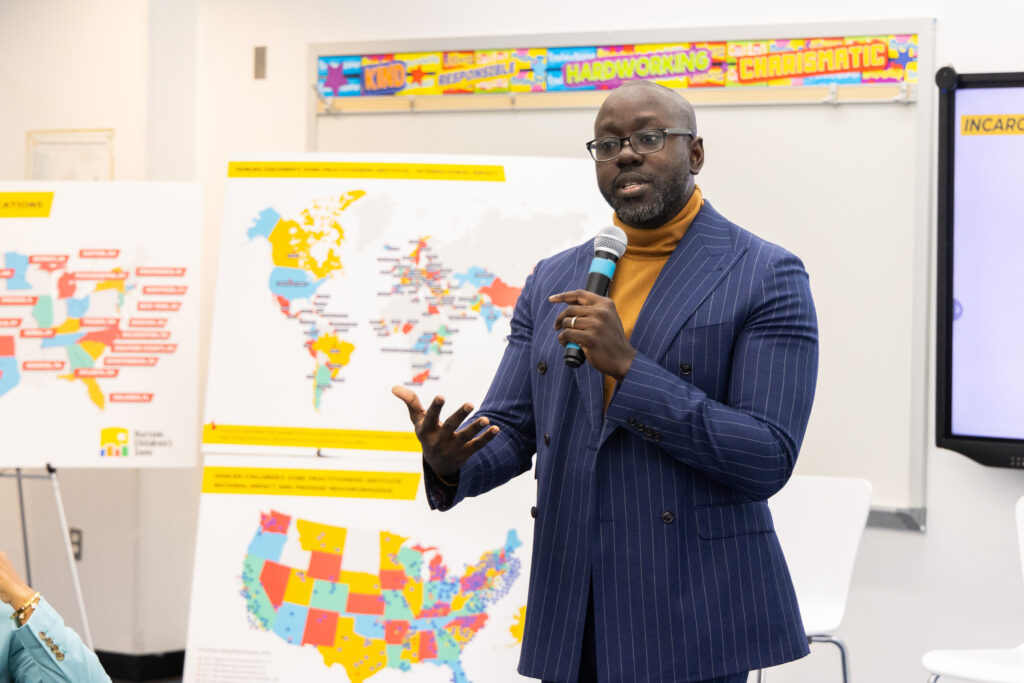
WJWI kicked off ELDF with a two-day immersive experience in Harlem. Fellows toured key HCZ sites, including HCZ Promise Academy I Charter School, Harlem Gems Preschool, and The HCZ Armory, gaining insights into how HCZ integrates education, social services, and community resources to drive outcomes.
They also heard from Mr. Canada and HCZ CEO Kwame Owusu-Kesse about the organization’s mission and impact, and how schools can lead the charge in transforming communities.
“We’re sharing what works so education leaders can replicate and expand it,” said Mr. Owusu-Kesse. “When schools anchor locally led partnerships, they create ecosystems that help children succeed in and beyond the classroom.”

Learning from Place-Based Leaders Across the Country
After visiting Harlem, fellows traveled to California, Massachusetts, and Miami to learn from place-based leaders and locally led partnerships. Their visits included:
- Oakland Promise and Mission Economic Development Agency in San Francisco
- Summer Institute: Transforming Place Through Neighborhood Leadership, a three-day event hosted by WJWI and The EdRedesign Lab at Harvard Graduate School of Education
- Power of Place: WJWI’s national convening that brings together hundreds of cross-sector leaders, practitioners, and policymakers dedicated to driving social and economic mobility, at scale, for the most vulnerable children and families in our country.

At Power of Place: It Takes a Village, the fellows dove into sessions on systems transformation, community-driven solutions, cross-sector collaboration, and more. Several ELDF members also led a panel, “Bridging Classrooms and Communities: The Role of K–12 Leaders,” featuring Dr. Tony Watlington Sr., Dr. Marty Pollio, and Dr. Leslie Torres-Rodriguez.
Looking ahead, WJWI will continue to support ELDF alumni as they advance their place-based initiatives. In July of 2025, fellows will reunite at Summer Institute to reflect on lessons learned, early wins, and next steps in building stronger cradle-to-career systems.

Scaling Systems Change through Local Leadership
The ELDF is more than a fellowship. It’s part of a national strategy to drive systems-level change. By equipping school leaders with actionable strategies, expert guidance, and a national network of peers, WJWI is reimagining how education systems partner with communities to drive impact for children and families.
Building on the ELDF’s momentum, WJWI launched Mayors’ Neighborhood Academy: One Million Points of Opportunity — an innovative new fellowship for city leaders. In partnership with the National League of Cities, the Academy convened 15 mayors and senior city officials from across the country, representing 3.5 million residents and over 700,000 youth, to help them adapt cradle-to-career strategies to the municipal level.
“With both ELDF and the Academy, we’re investing in the leaders best positioned to align systems, mobilize resources, and drive lasting change,” said Christian Rhodes, Deputy Executive Director of WJWI. “This is how we build a movement — community by community, city by city — until every child has a path to opportunity.”